Varden™ Plastic vs. Concrete: An Honest Look at Materials, Carbon, and Long‑Term Benefits
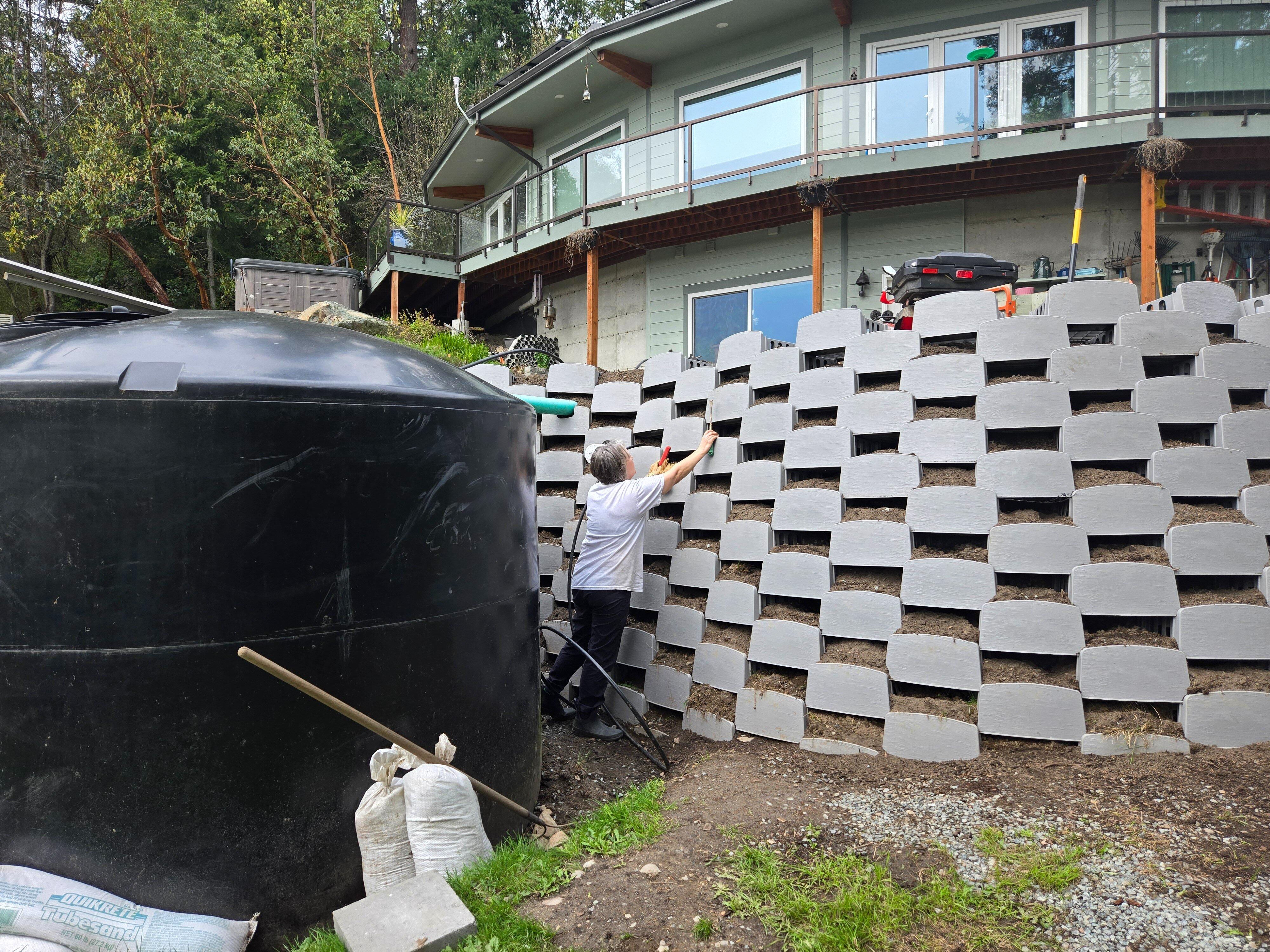
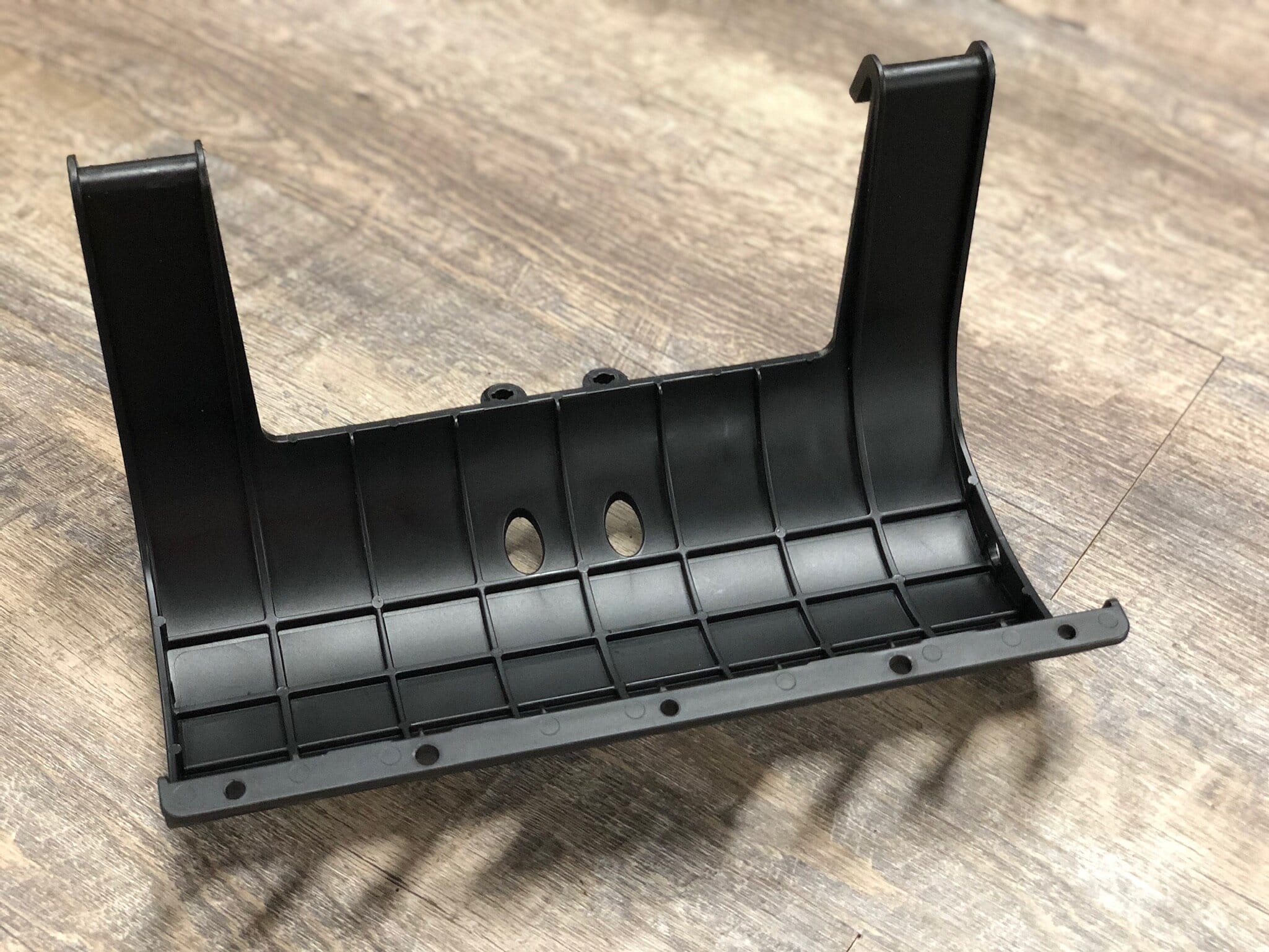
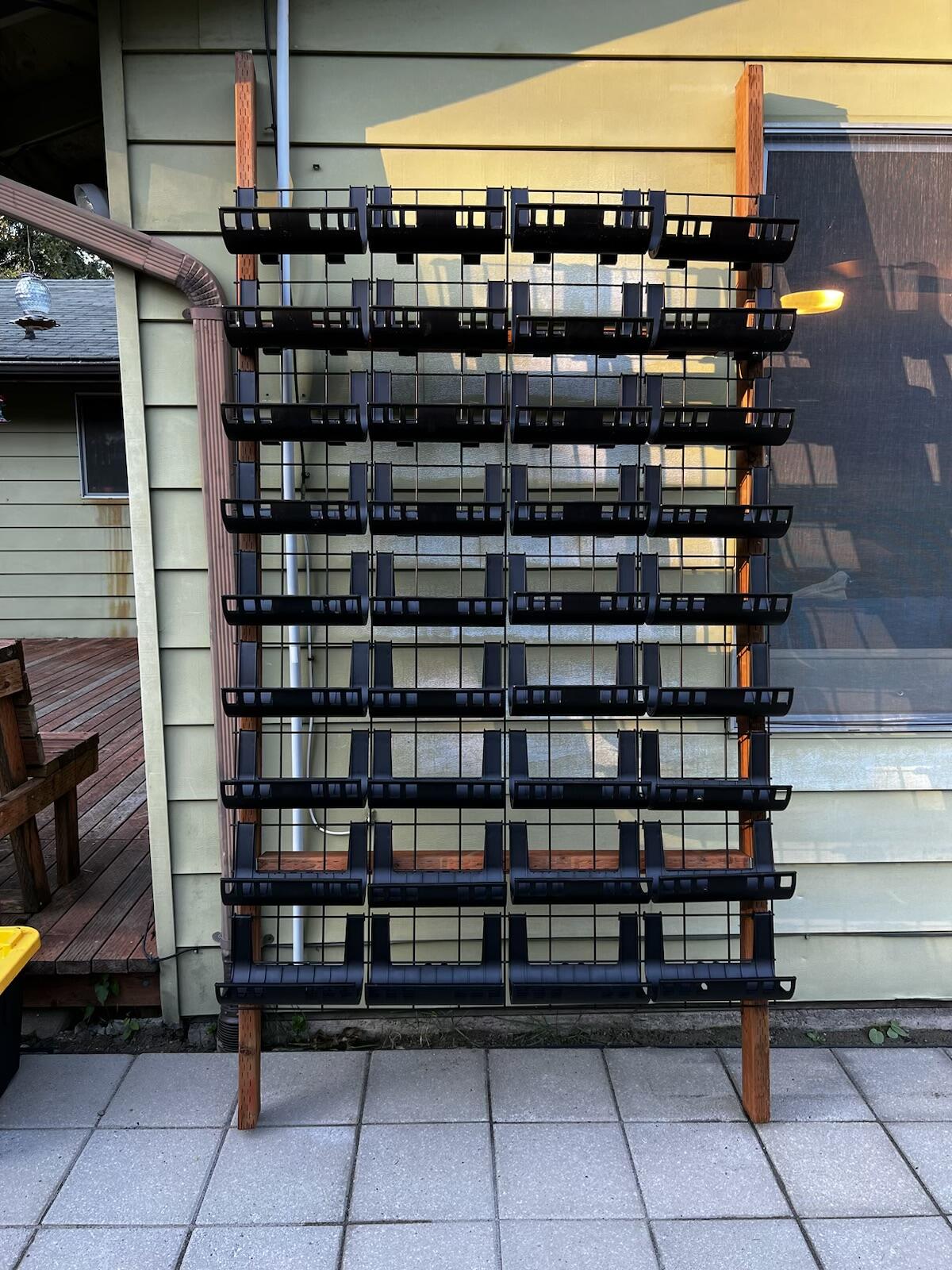
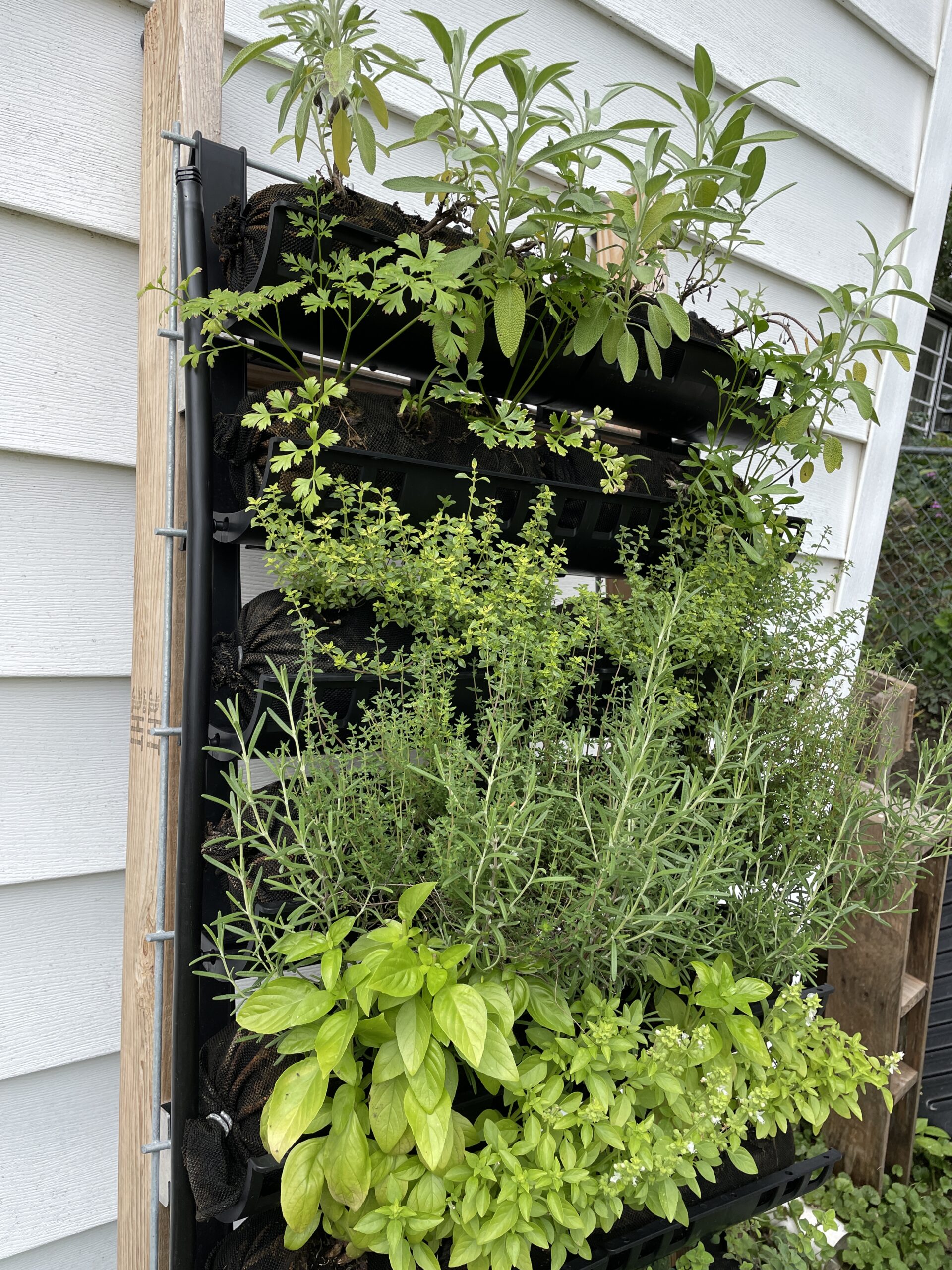
Varden™ plantable retaining wall blocks are made from structural‑grade polypropylene (PP), not concrete, and that choice is intentional. The blocks are designed to work with soil, compost, and dense vegetation to build a living wall system that is structurally sound, long‑lasting, and environmentally beneficial over the long term.
Why We Chose Engineered PP Instead of Concrete
Many people instinctively feel better about concrete than plastic when they think about “permanent” structures. At the same time, we all see the real problems that come from poorly used plastics—single‑use packaging, litter, and microplastics in oceans and rivers. Those concerns are valid and we take them seriously.
But traditional concrete retaining wall blocks carry their own heavy footprint:
- Portland cement is one of the most carbon‑intensive industrial materials on earth.
- Stone and sand must be mined, crushed, screened, graded, and hauled to the plant.
- Finished blocks are extremely heavy, requiring more fuel and larger equipment to deliver and install.
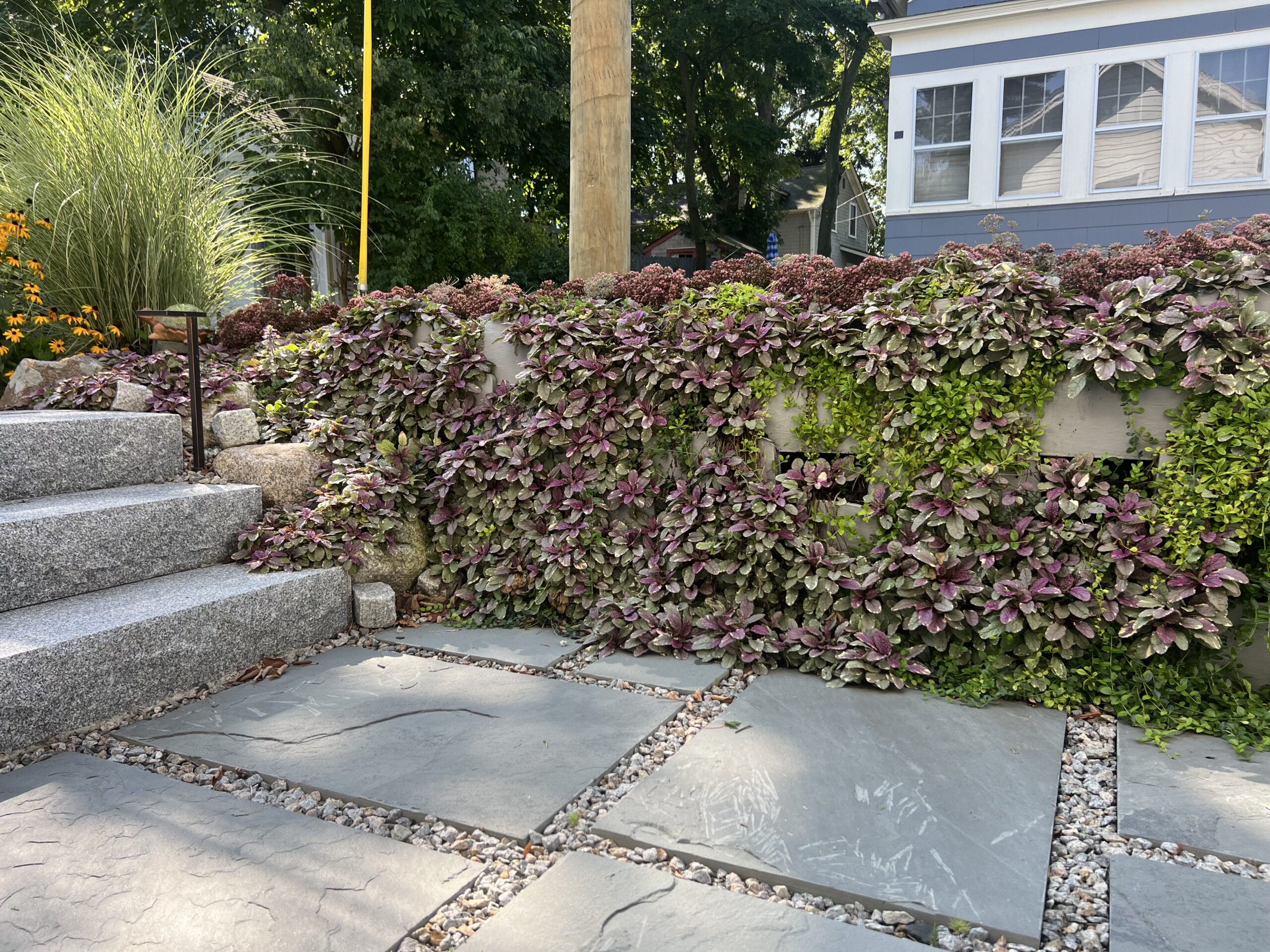
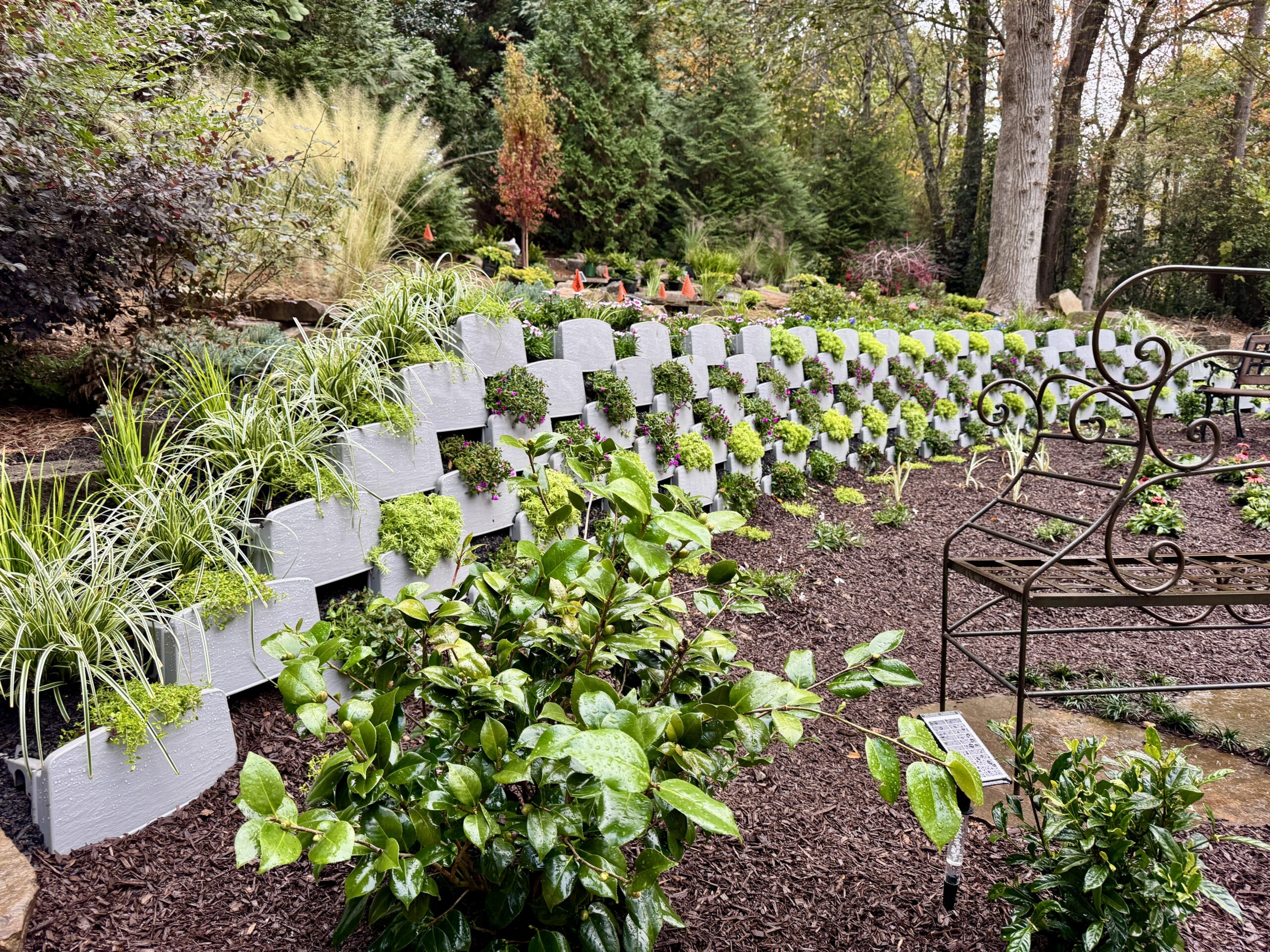
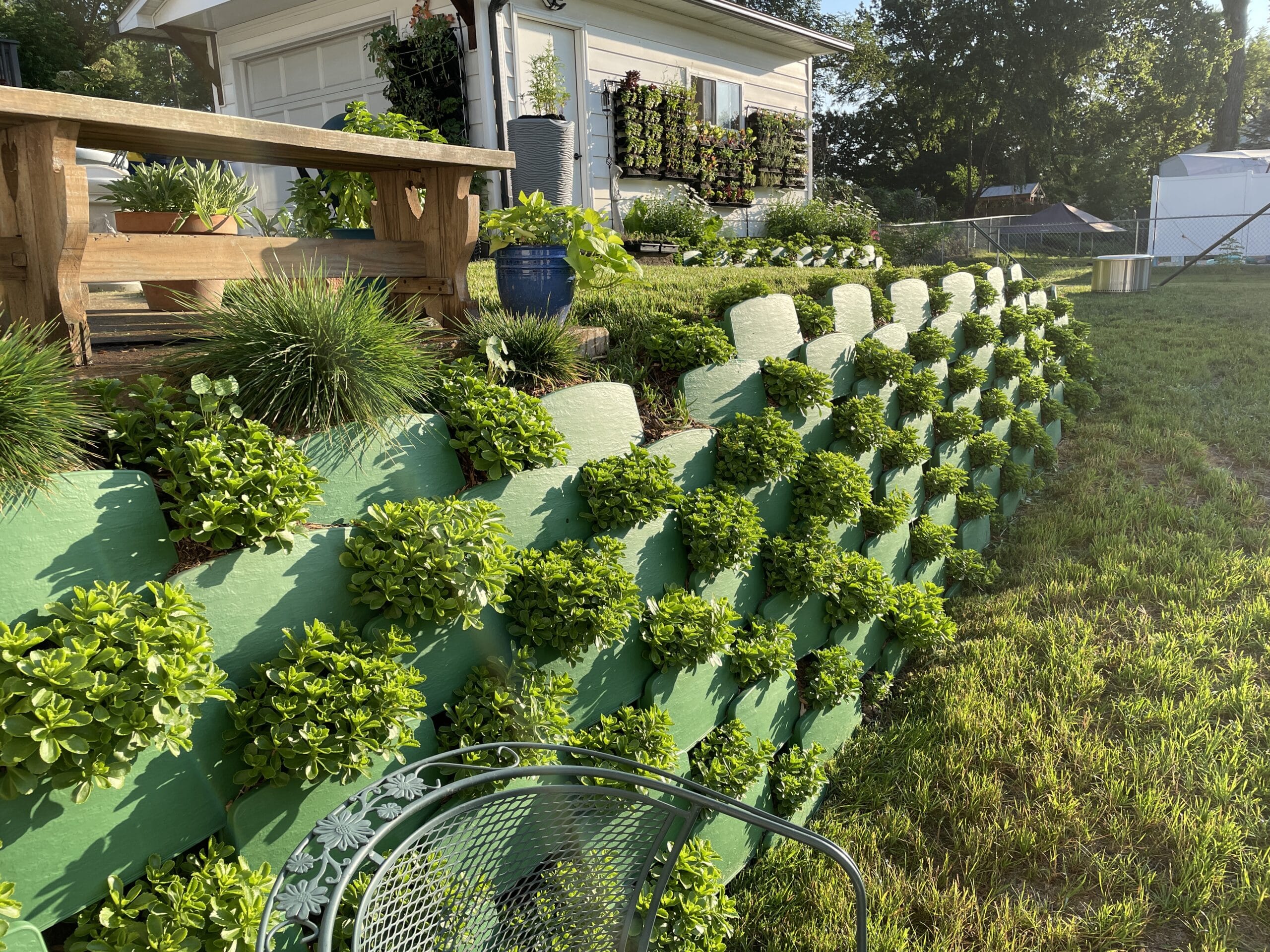
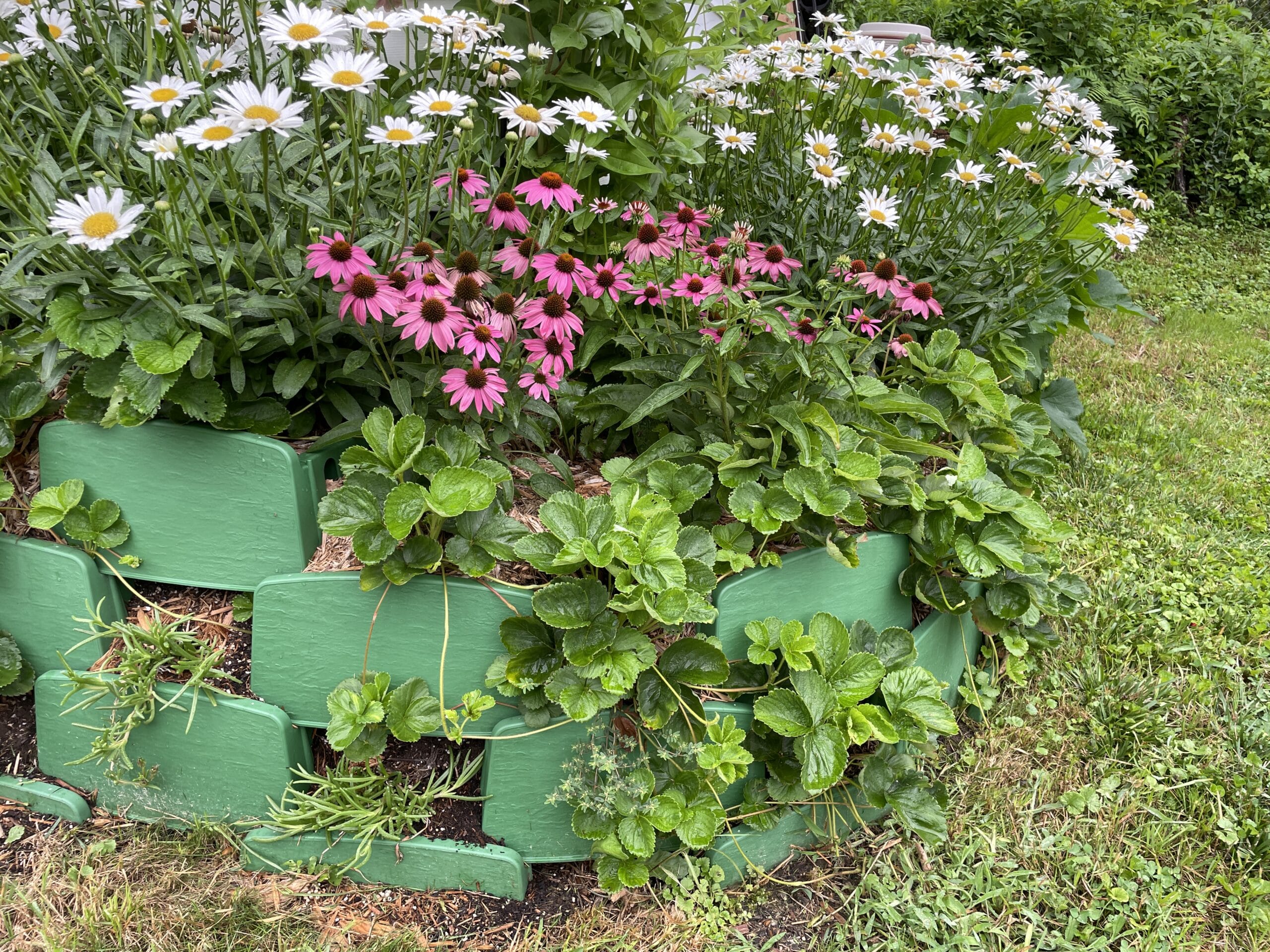
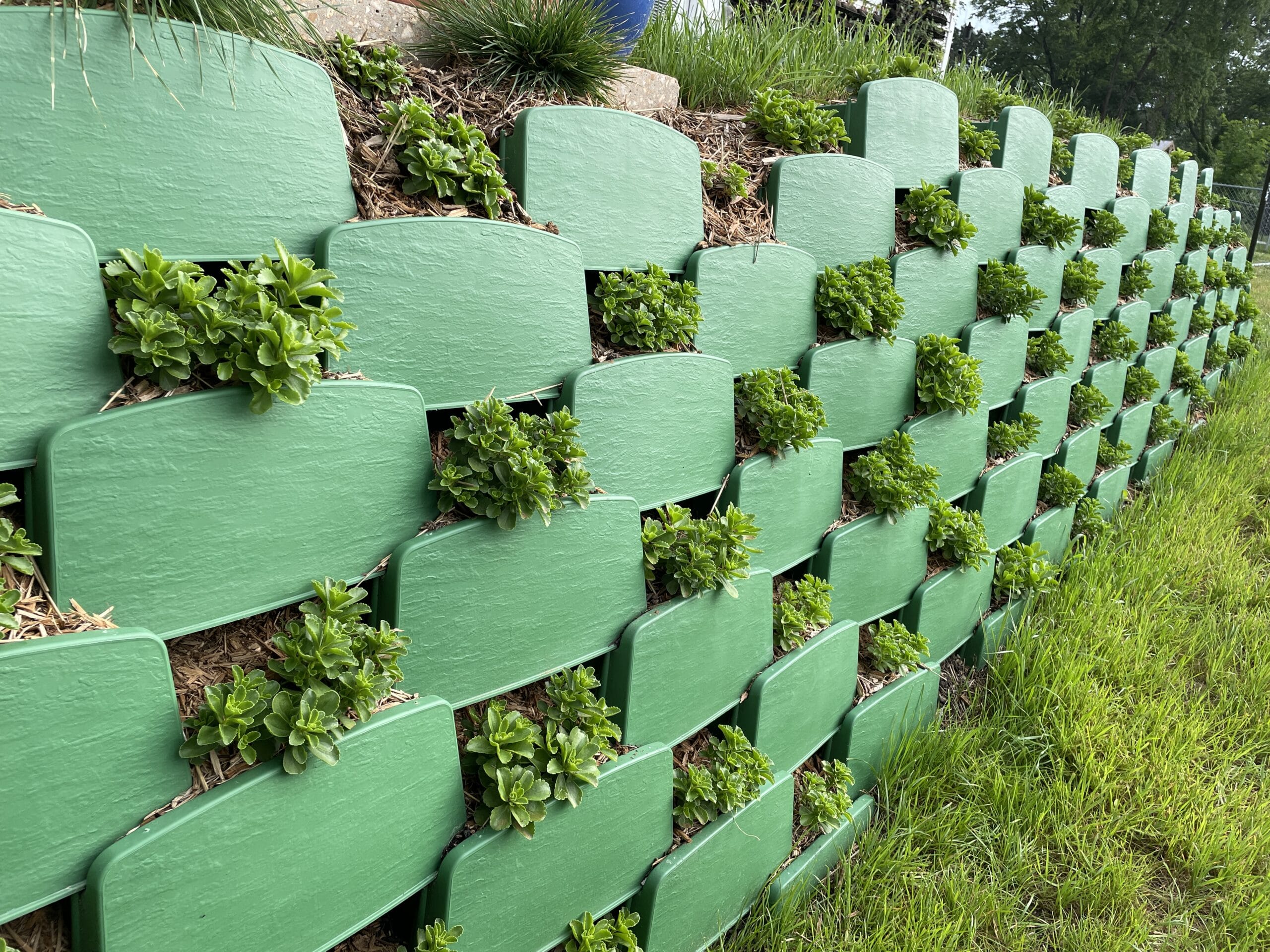
Varden™ plantable retaining wall blocks take a different path. We use a relatively small amount of high‑performing PP to create a precise, lightweight structural “shell” that holds a large volume of soil or compost and supports plants. The wall’s visible surface becomes living green infrastructure instead of bare concrete.
In other words: the plastic is there to enable the wall to function as soil, roots, and foliage—not as a solid, heat‑absorbing mass of concrete.
What Varden™ Blocks Are Made Of
Varden™ blocks are injection‑molded from tough, structural PP resin formulated for outdoor use. This material is widely used in construction, automotive components, and even food‑contact applications because of its strength, stability, and chemical inertness.
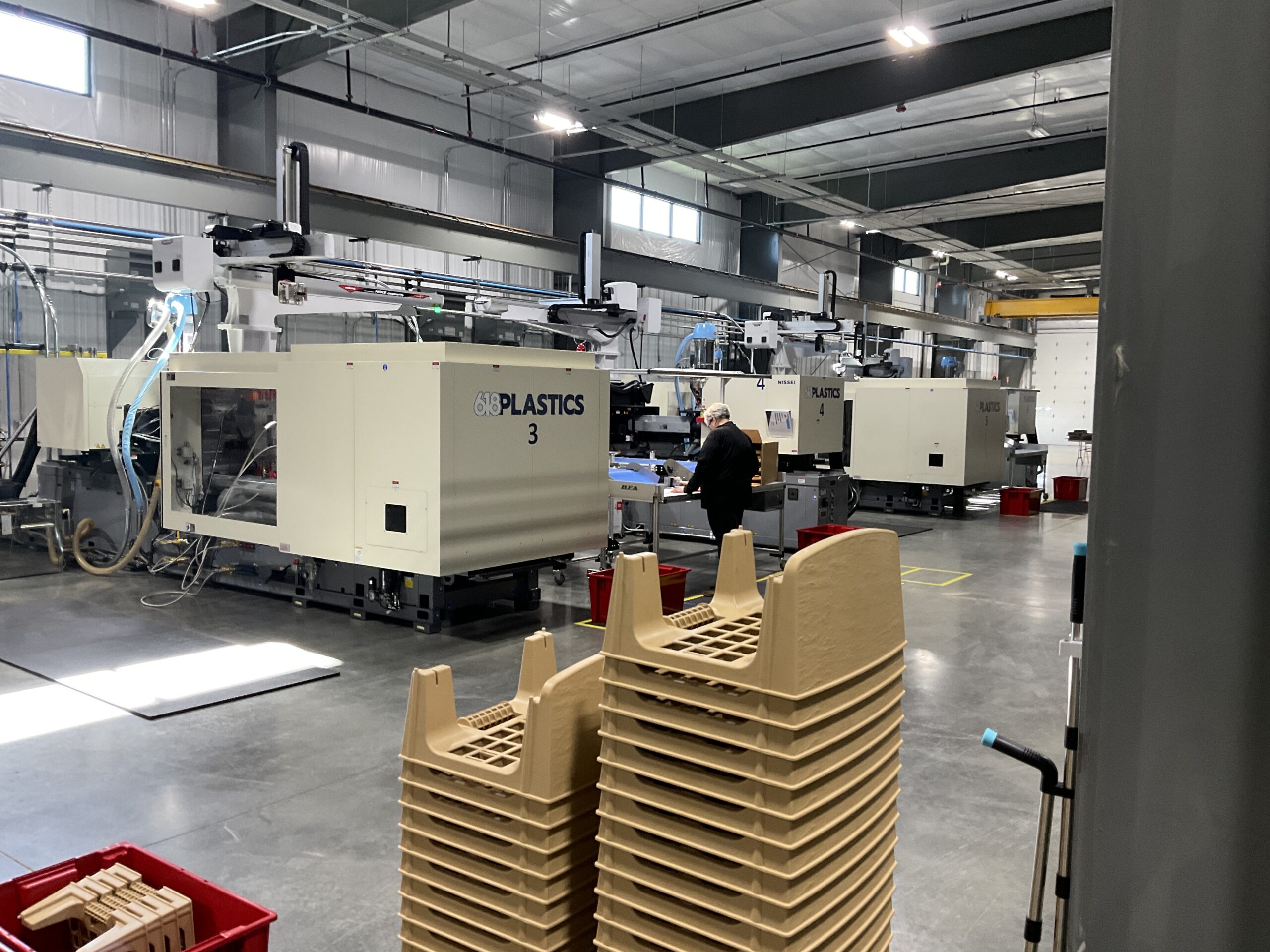
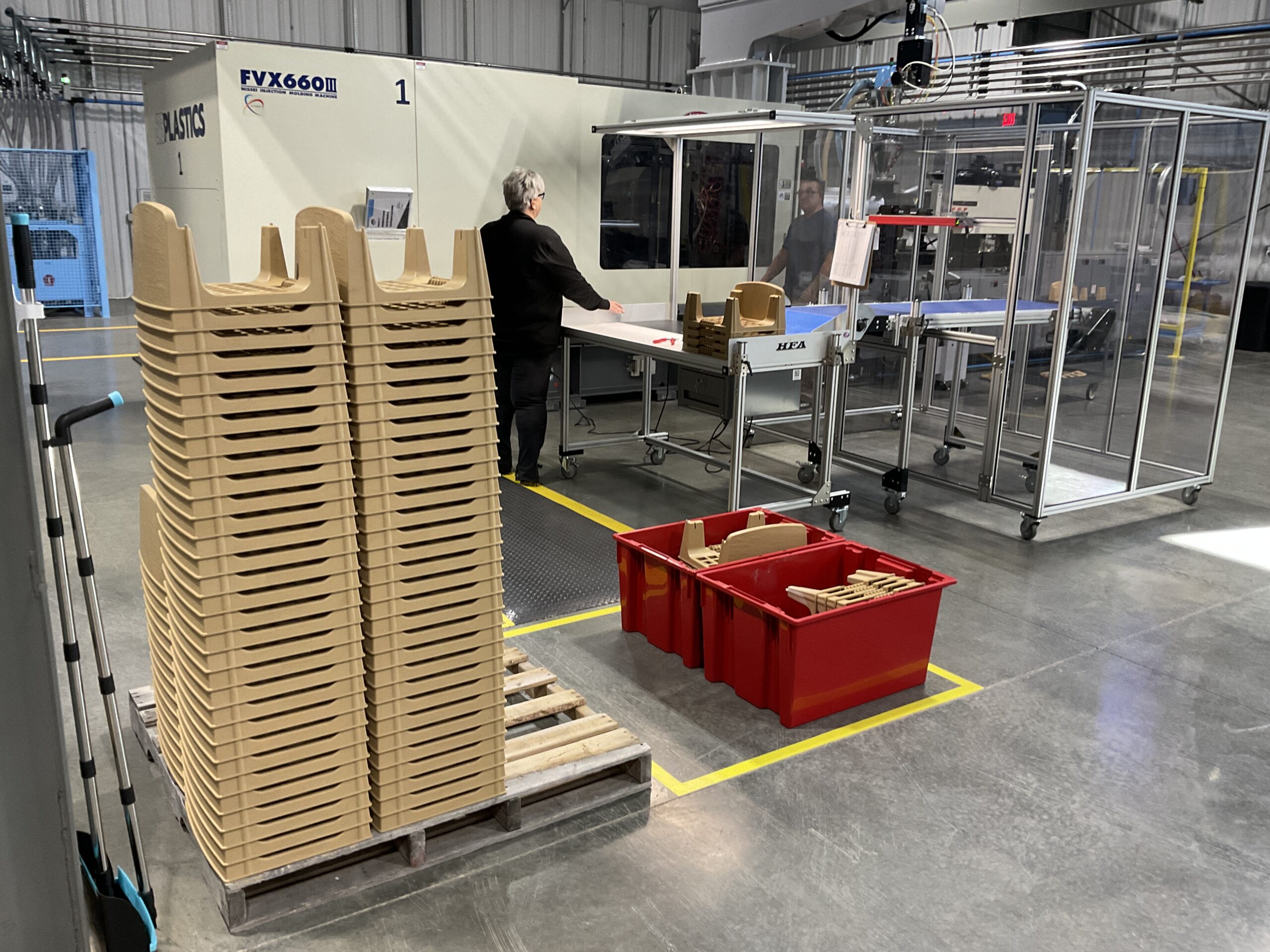
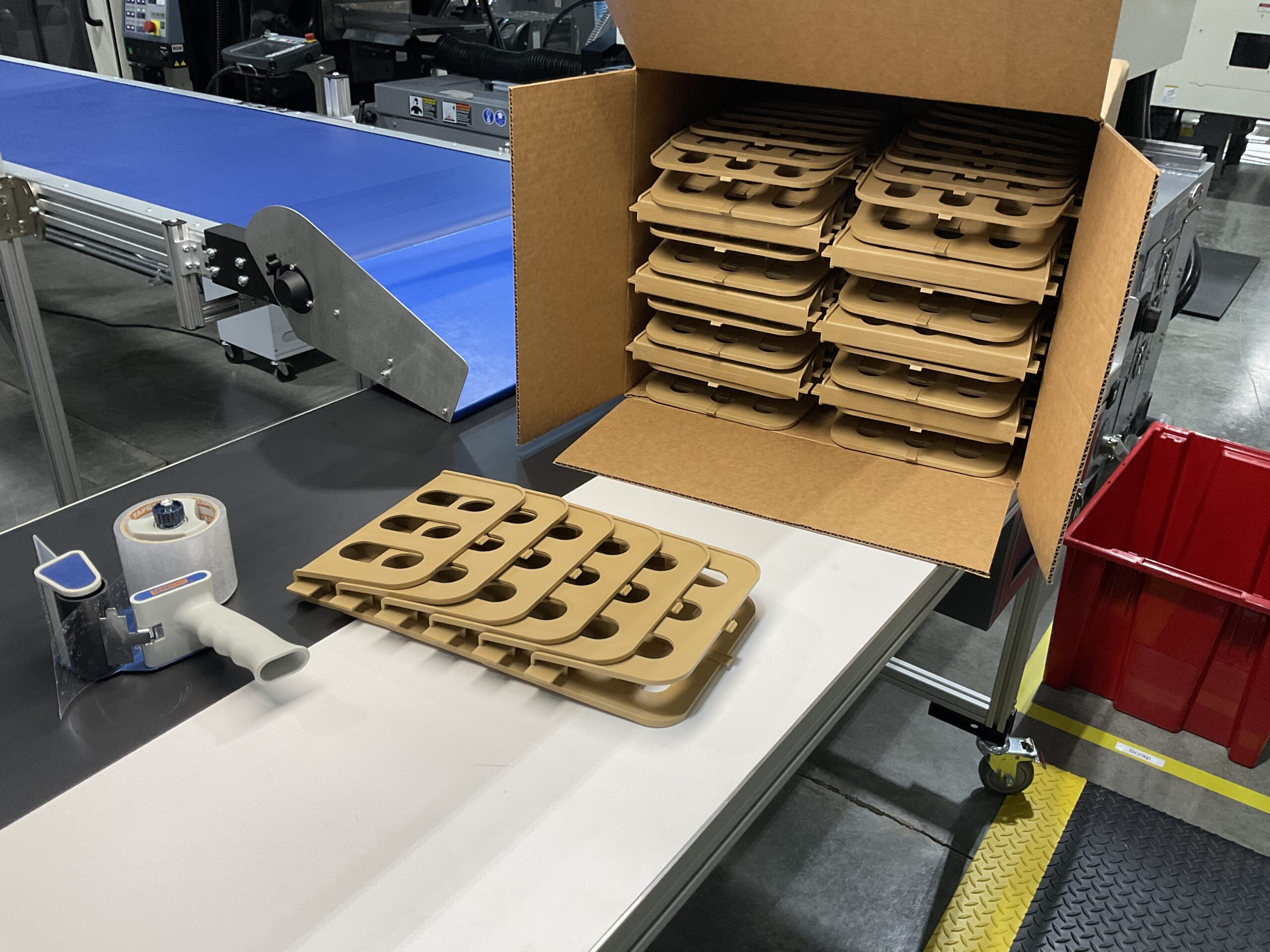
Our formulation is designed specifically for retaining walls:
- Structural‑grade PP with excellent impact resistance and fatigue strength.
- A UV stabilizer package to protect blocks during manufacturing, storage, transport, and any exposed service.
- Impact modifiers that improve toughness and help resist cracking.
- Mineral pigments in gray, tan, brown, and green to blend naturally with soil and vegetation.
Key characteristics of PP that matter here:
- Very low water absorption, so it does not wick moisture or weaken when wet.
- Resistance to freeze‑thaw cycles because water cannot penetrate and expand inside the material.
- Chemically inert in typical soils, irrigation water, and fertilizers.
The result is a precise, repeatable, long‑life “container” for soil and plants—strong enough for retaining wall duty, yet light enough to ship and handle without heavy machinery.
Durability and Service Life in a Real Wall
What matters most is how the material behaves where it’s actually used: buried in soil, with the exposed face covered by plants.
In a finished Varden™ wall:
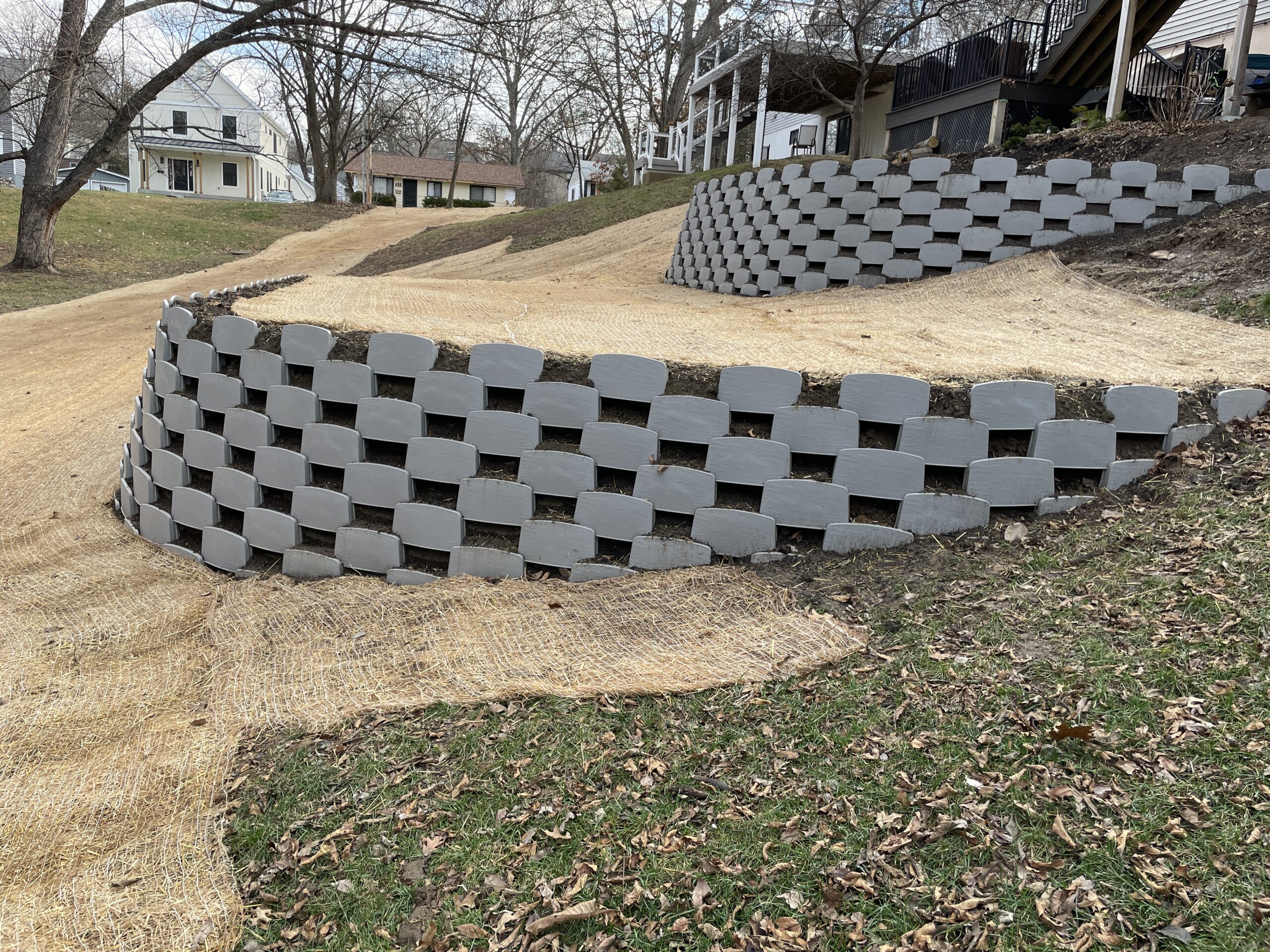
- The blocks are almost completely surrounded by backfill.
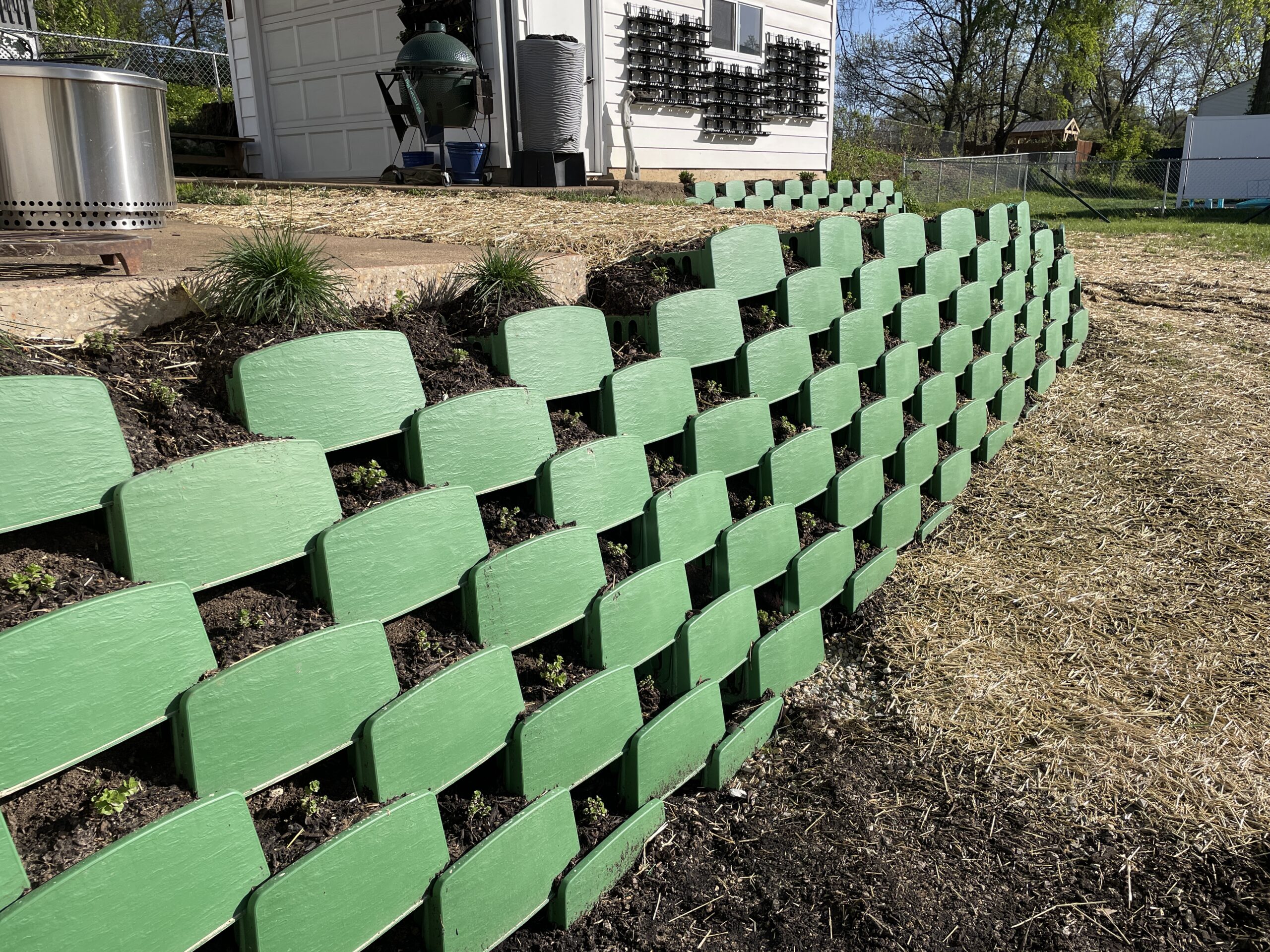
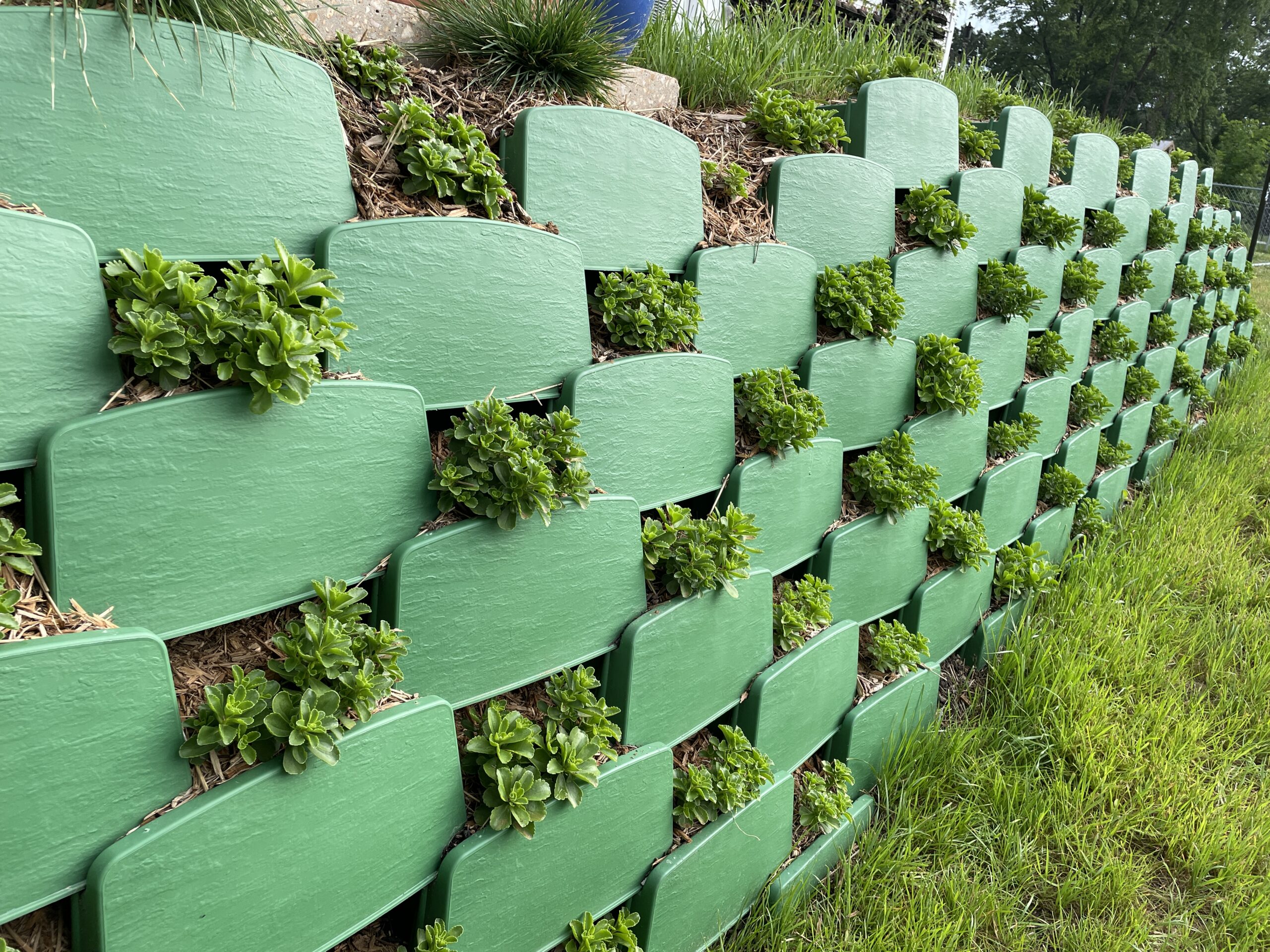
- The exposed faces are intended to be fully planted, so the plastic is shaded by leaves and stems.
- The wall is built as an engineered system, with proper drainage, backfill, and, where needed, geogrid or other reinforcement.
This configuration has important durability advantages:
- Minimal UV exposure in normal use The UV stabilizer protects the blocks during storage and installation. Once planted, the combination of soil cover and vegetation dramatically reduces long‑term UV exposure compared to fully exposed plastic products.
- No freeze‑thaw spalling like concrete Concrete is porous and can absorb water; repeated freeze‑thaw cycles can crack or flake the surface of concrete retaining wall blocks over time. PP is essentially non‑porous, so freezing water cannot enter and expand inside the material.
- Loads distributed through the system, not just the block A properly designed retaining wall relies on gravity, friction, backfill, drainage, and reinforcement.
The block is a structural component, but not the only thing holding back the slope. Varden™ block geometry and interlock are engineered to work within standard wall design practices. See what a wall design engineer has posted about Varden Retaining Walls here.
Under typical conditions, when the wall is designed and built to engineered standards, the limiting factor in long‑term performance is usually the geotechnical design and site conditions—not the PP itself. In this use, it is reasonable to treat the block as a multi‑decade component, with an expected service life on the order of a century or more.
For transparency: Verdtech offers a two‑year warranty on the block products themselves. That warranty covers manufacturing defects but does not define or limit the much longer expected service life of a properly engineered and installed wall.
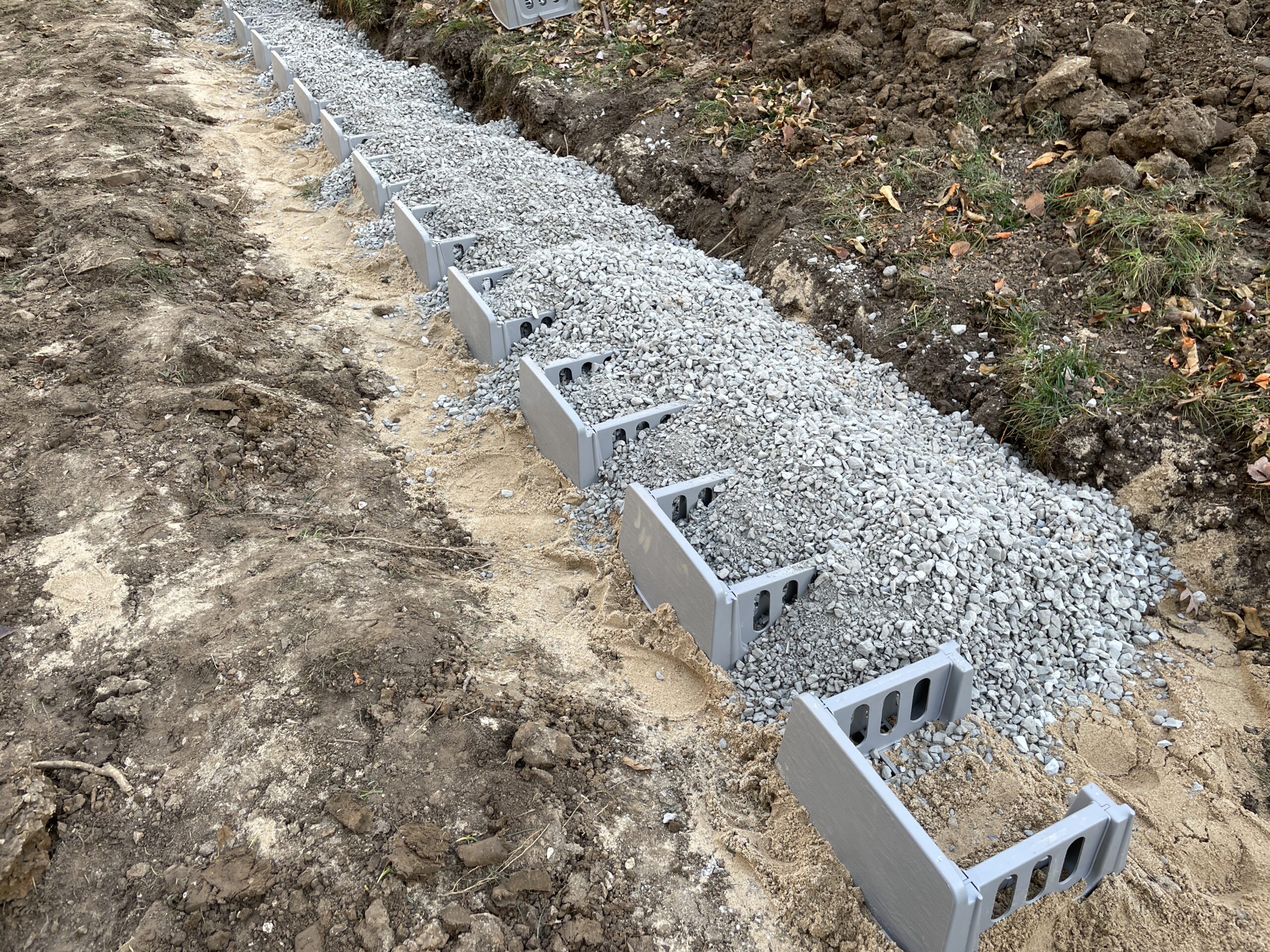
Transport and Installation: Why Weight Really Matters
Concrete’s weight is often equated with strength, but it comes with environmental and practical costs.
A typical concrete retaining wall block in the range Varden competes with often weighs 50–100 pounds per unit. To deliver enough of those units for a sizable wall, it is common to load an entire 18‑wheel flatbed with tens of thousands of pounds of concrete.
By contrast:
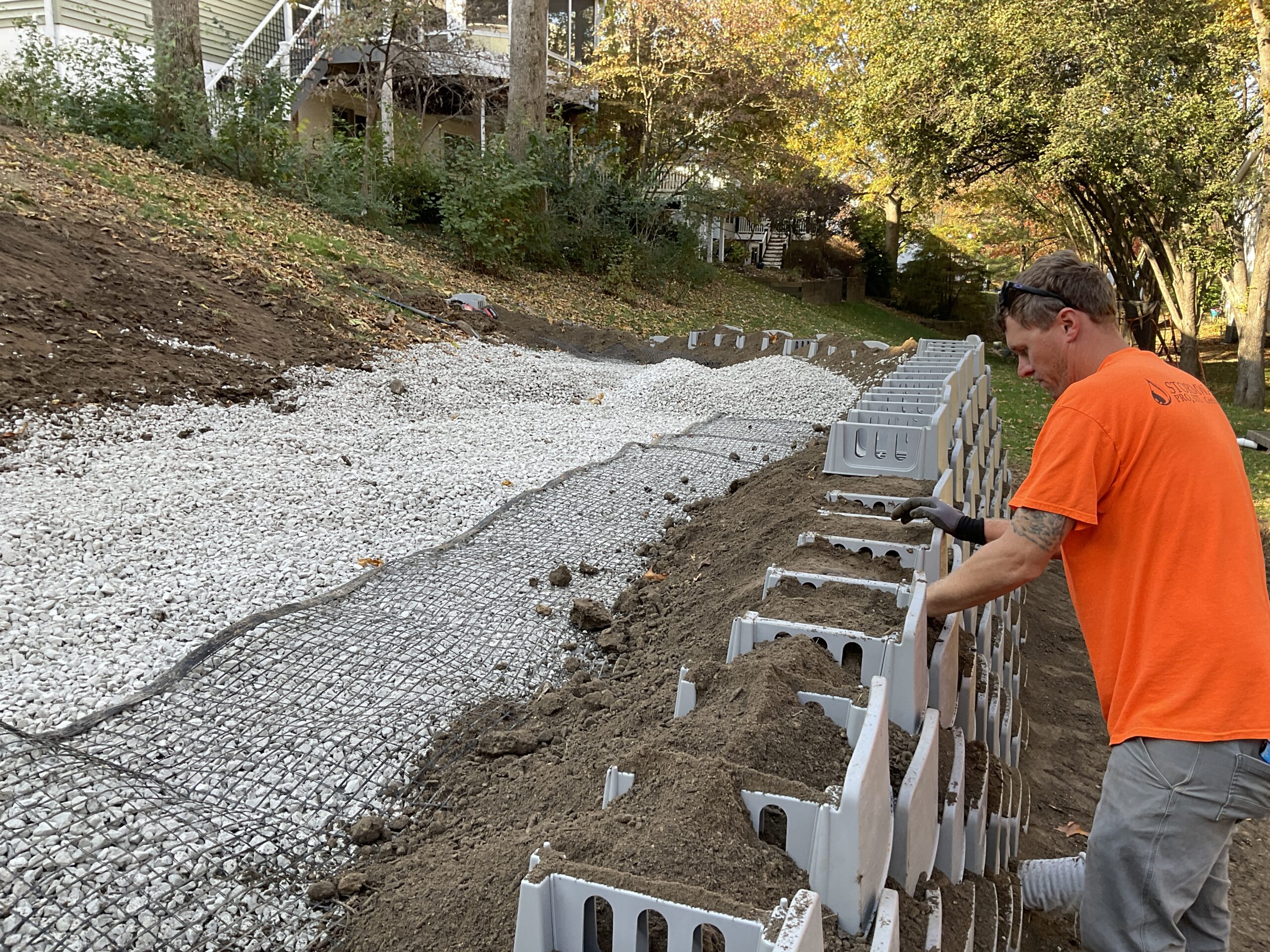
- Each Varden block covers 1 square foot of wall face.
- Each block weighs only a few pounds.
- A single 48” x 48” pallet of 250 blocks weighs roughly 800 pounds and covers 250 square feet of wall.
This means one compact pallet can build nearly as much wall face as a full semi load of concrete units.
The implications:
- Far less fossil fuel burned per square foot of wall delivered.
- Lower transport‑related emissions for projects, especially over long distances.
- Easier and safer handling on site, often without heavy equipment.
- Faster installation and less strain on crews and DIY users.
Instead of pouring energy and emissions into moving rock around, Varden™ puts that “budget” into design and function.
Concrete’s Embodied Carbon: From Quarry to Block
The environmental cost of a concrete block is not just what’s baked into the cement—it’s everything that happens before it reaches your wall.
For each traditional concrete retaining wall block, there is a chain of steps:
- Rock is blasted or dug from a quarry.
- Aggregates are crushed, screened, and graded to size.
- Cement is produced in high‑temperature kilns that emit large amounts of CO₂.
- Cement and aggregates are hauled to a concrete plant.
- Blocks are mixed, cast, cured, and then shipped again to the project site.
At each stage, heavy equipment and trucks burn fuel. By the time a concrete block is in your hand, it embodies energy and emissions from multiple rounds of mining, processing, and hauling—not just from the cement inside it.
Because concrete blocks are so heavy, these “material miles” add up quickly.
The Environmental Case for Varden
Even without emphasizing recycled content, you can look at Varden walls through three lenses: material mass, wall‑level performance, and the way the system interacts with the carbon cycle.
- Less material mass per square foot of wall
A Varden™ wall uses:
- A small mass of PP per square foot of face.
- A large volume of soil or compost in the block pockets.
- Plant biomass that grows over time.
A comparable concrete wall uses:
- Dozens of pounds of concrete per square foot, much of it cement and aggregates that have been mined, fired, and hauled more than once.
Even though PP is a petroleum‑based material with its own footprint, the total mass of PP in a Varden wall is low compared with the mass of concrete that would otherwise be used. When you factor in transport, this difference becomes even more important.
- Wall‑level carbon and energy, not just material comparison
If you look at environmental impact per kilogram of material alone, concrete and PP each have their issues. The more meaningful comparison, though, is per square foot of wall built and delivered over its full life:
- Varden™ needs far fewer truck miles per project because it moves less weight.
- On site, lighter blocks mean less equipment and potentially fewer trips.
- The system is designed to last for decades without the surface spalling and cosmetic deterioration that often lead to repair or replacement of exposed concrete walls.
The question is not only “What is the footprint of a kilogram of material?” but “What is the footprint of this wall doing its job for a very long time?”
- The wall as soil and plant infrastructure
Perhaps the most important difference: Varden walls turn the retaining structure into a series of planted soil pockets.
- Each block pocket is filled with soil or compost, which stores carbon as organic matter.
- Plants in each pocket take in CO₂ every year through photosynthesis, storing carbon in their leaves, stems, and roots.
- Root systems and decaying plant material feed soil biology, helping build stable soil organic carbon over time.
- The vegetated surface cools the local microclimate, intercepts rainfall, and provides habitat—benefits a bare concrete wall cannot provide.
From a carbon‑cycle perspective, you are not just comparing PP to concrete; you are comparing a living, soil‑and‑plant system to an inert, mineral one.

LEED and Green Building Considerations
Many projects today aim for certification under programs like LEED (Leadership in Energy and Environmental Design). While Varden blocks by themselves are not a “single‑product LEED credit,” they can support multiple sustainability goals when integrated thoughtfully.
Here are a few ways they can contribute:
- Reduced transport emissions Lighter blocks and fewer truckloads help design teams demonstrate efforts to cut embodied carbon in sitework and landscape elements.
- Support for green infrastructure Varden walls add vegetated vertical surface area, helping address heat‑island effects, improve site ecology, and support resilient site design.
- Compatibility with broader embodied‑carbon strategies As owners and design teams seek to reduce total embodied carbon in structure and site elements, substituting some heavy, cement‑intensive components with lighter, long‑life PP systems can be part of a holistic strategy, especially when the system also adds ecological function.
If your project team needs help documenting the Varden™ system within a green building framework, Verdtech can provide product data and coordinate with designers to integrate the wall into their overall sustainability narrative.
Direct Answers to Common Concerns About Plastic
We regularly hear a few questions about using plastic in a retaining wall. Here are straightforward answers.
“Won’t plastic degrade in the sun and get brittle?”
Thin, exposed plastics that weren’t designed for long‑term outdoor use can become brittle. Varden™ blocks are different:
- They are made from structural‑grade PP with UV stabilizers and toughness enhancers.
- In a finished wall, blocks are mostly buried and shaded by plants, drastically reducing UV exposure.
- They are rigid modules supported by soil and interlock, not thin films flexing in the wind.
In the environment we designed for, loss of strength from UV exposure is not expected to be a limiting factor.
“Is plastic really strong enough for a retaining wall?”
Retaining walls work as systems. The block, backfill, drainage, and reinforcement all share the load.
- Varden™ blocks are engineered with geometry and interlocks that work with standard retaining‑wall design practices.
- PP offers excellent impact resistance and fatigue performance when properly formulated and molded.
- Real‑world installations have demonstrated that, in the right design envelope, these blocks perform as expected in the field.
- The wall does not rely on raw mass alone; it relies on smart engineering and robust material.
“Isn’t plastic worse for the environment than concrete?”
In some uses—especially short‑life packaging—plastic can indeed be more problematic. In this specific use, however, the picture is different:
- We use a small mass of PP per square foot of wall to avoid much larger masses of cement and aggregate.
- We move far less weight per project, reducing hauling energy and emissions.
- We create a planted wall that actively stores carbon in soil and plants over its service life.
Instead of asking “Is plastic good or bad?” we ask, “Is this a smart, high‑value use of plastic compared with the alternative?”
“Will plastic leach into the soil or harm edible plants?”
PP is widely used in food‑contact containers, closures, and other applications precisely because it is chemically stable and has low migration under normal conditions.
- In a Varden™ wall, the material is in contact with soil and water at ambient temperatures.
- Surface area of plastic relative to soil volume is modest.
- The material is essentially inert in typical landscape soils.
Using PP as the structural shell for a planted retaining wall is consistent with long‑standing use of PP in nursery pots, irrigation components, and many food‑related applications.
A Deliberate, High‑Value Use of Plastic
The real question is not whether PP is impact‑free—it is not. The question is whether we are using it in a way that creates more long‑term environmental value than the alternative.
In Varden™ plantable retaining walls, plastic is:
- Used sparingly, in a high‑value, multi‑decade structural application.
- Enabling a wall that would otherwise be solid concrete to become a planted, living surface.
- Allowing huge reductions in transport weight and associated emissions per square foot of wall.
- Supporting soil and plant systems that store carbon and improve local microclimates instead of contributing to heat islands.
For homeowners, landscape professionals, engineers, and designers who want retaining walls that are structurally sound and environmentally thoughtful, Varden offers a different path: less concrete, less mass, a carefully chosen engineered plastic, and a wall that becomes a living asset for decades to come.

Share This Story, Choose Your Platform!
Related Posts
About the Author: Mark Woolbright